
IP Metropolitan Area Network (IP MAN): Enterprise Connectivity for Modern SaaS and Cloud Networks
In today’s rapidly evolving digital landscape, businesses rely heavily on cloud computing, SaaS applications, and high-speed internet connectivity. As organizations scale, local area networks (LANs) are no longer sufficient to meet growing data demands. This is where IP Metropolitan Area Networks (IP MANs) play a critical role.
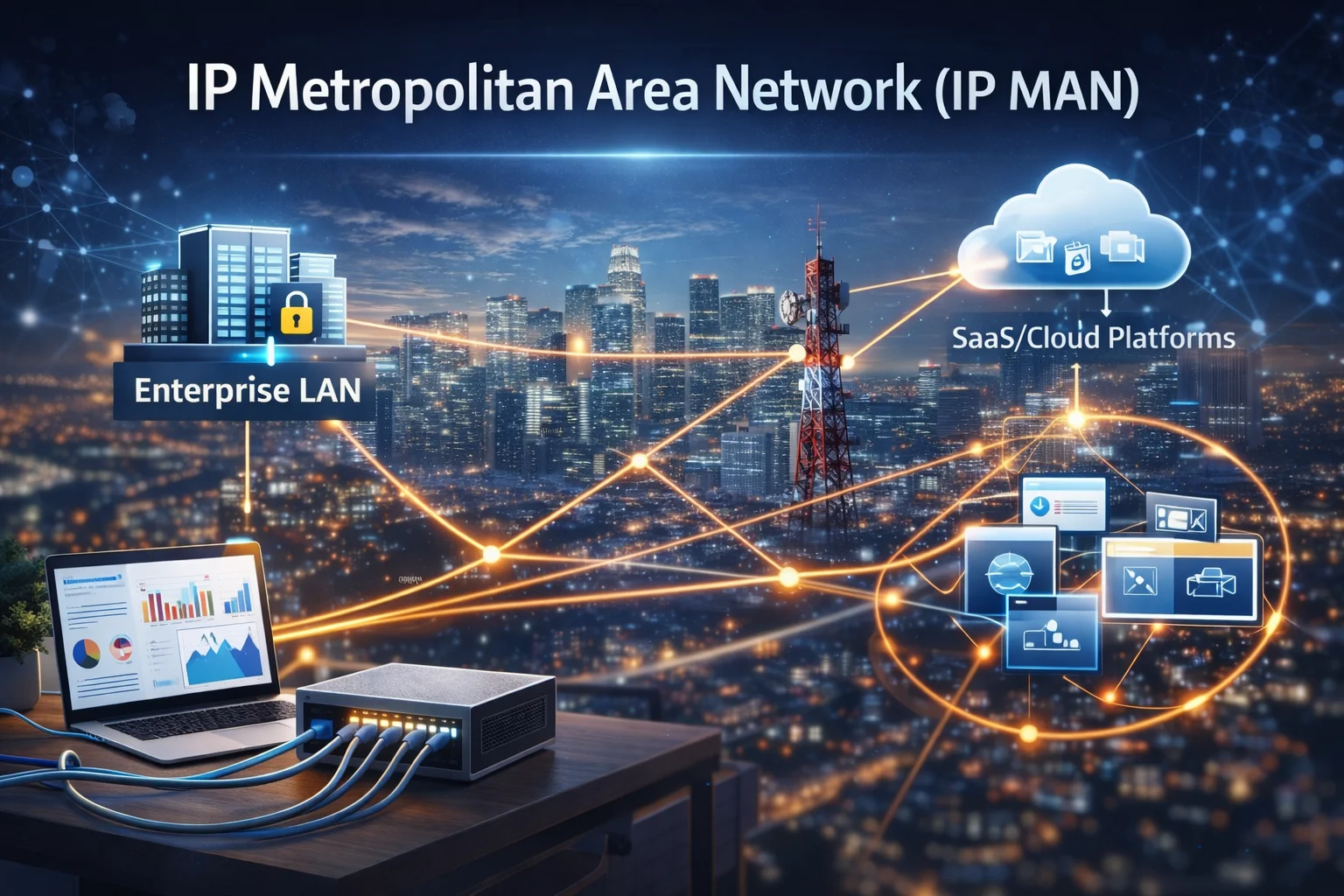
An IP MAN is a high-speed network connecting multiple LANs across a metropolitan area, providing enterprises, service providers, and SaaS platforms with reliable, scalable, and secure connectivity. Unlike traditional WANs, IP MANs offer enhanced performance, lower latency, and better support for modern applications.
This article explores IP MANs in depth, covering their architecture, benefits, applications in SaaS and cloud networks, deployment strategies, challenges, and future trends. Whether you’re a network engineer, IT leader, or SaaS founder, understanding IP MANs is crucial for designing high-performance networks that can support modern business operations.
What Is an IP Metropolitan Area Network (IP MAN)?
An IP Metropolitan Area Network is a network that spans a city or metropolitan area, connecting multiple LANs, enterprise locations, data centers, or cloud access points.
Key characteristics include:
- Geographic coverage: Larger than LANs, smaller than WANs. Typically spans tens of kilometers within a city or region.
- IP-based infrastructure: Uses IP protocols for routing and management.
- High-speed connectivity: Often implemented with fiber optic links, MPLS, or other high-capacity technologies.
- Supports modern applications: Optimized for SaaS platforms, cloud services, video conferencing, VoIP, and enterprise data traffic.
Unlike WANs that may span countries, IP MANs are metro-focused, providing lower latency, higher reliability, and centralized management for city-scale enterprise networks.
Why IP MANs Are Critical for Modern Enterprises and SaaS
1. Reliable Cloud Connectivity
SaaS and cloud platforms require consistent, high-speed access across multiple offices. IP MANs ensure low-latency connections, enabling smooth access to business-critical applications like CRM, ERP, and collaboration tools.
2. Scalable Enterprise Networks
As companies expand within cities or regions, IP MANs allow easy addition of new sites, data centers, or cloud endpoints without major infrastructure changes.
3. High-Performance Support for Applications
Bandwidth-intensive applications like video streaming, cloud analytics, and remote collaboration benefit from the high throughput provided by IP MANs.
4. Enhanced Security
IP MANs can integrate advanced security measures, including firewalls, VPNs, and segmentation, reducing exposure to cyber threats while maintaining enterprise-grade performance.
Core Components of an IP MAN
A typical IP MAN consists of several key components:
- High-Speed Backbone:
Fiber-optic cables, Ethernet backbones, or MPLS networks connect multiple nodes. - Edge Routers and Switches:
Connect enterprise LANs to the MAN, ensuring efficient traffic routing. - Network Management Systems (NMS):
Monitor performance, detect anomalies, and manage network resources dynamically. - Redundancy and Failover:
Ensures continuous operation even if a link or device fails. - Security Infrastructure:
Firewalls, intrusion detection, and access control maintain enterprise-level security across the metropolitan network.
IP MAN Architecture
IP MAN architecture can vary depending on the network size and organization requirements. Common architectures include:
- Ring Topology: Provides redundancy and efficient routing for metro-scale networks.
- Mesh Topology: Offers maximum resilience and fault tolerance for enterprise-critical networks.
- Hybrid Topology: Combines multiple topologies to balance performance, cost, and reliability.
Most IP MANs now integrate SDN (Software-Defined Networking) and AI-driven adaptive network control, which allows dynamic optimization of bandwidth, traffic routing, and application performance. You can read more about this in our guide on adaptive network control.
Applications of IP MANs in SaaS and Cloud Networks
1. SaaS Platform Delivery
IP MANs ensure consistent access to SaaS applications across multiple branch offices or enterprise locations.
2. Cloud Data Center Connectivity
High-speed links between cloud data centers within a metropolitan area reduce latency for distributed applications.
3. Enterprise Collaboration
Supports high-bandwidth applications like video conferencing, file sharing, and unified communications.
4. Internet Service Providers
ISPs use IP MANs to connect multiple customer nodes within a metro region, improving service quality and reliability.
Benefits of Implementing IP MANs
- High Reliability: Redundant links prevent network downtime.
- Low Latency: Optimized routing reduces delays for critical applications.
- Scalability: Easily add new nodes, offices, or cloud endpoints.
- Centralized Management: Simplifies network monitoring and troubleshooting.
- Enhanced Security: Supports segmentation, firewalls, and secure VPNs.
- Cost Efficiency: Reduces dependence on long-haul WAN connections.
Challenges of IP MAN Deployment
Despite their advantages, IP MANs present several challenges:
- High Initial Investment: Fiber optic installation and MPLS services can be expensive.
- Complex Network Design: Requires careful planning of topology, routing, and redundancy.
- Ongoing Management: Needs skilled network engineers and sophisticated monitoring tools.
- Integration with Legacy Systems: Connecting old networks or hybrid environments can be complex.
Solutions often include cloud-managed IP MAN services or leveraging AI-assisted network management for real-time optimization.
Future Trends in IP Metropolitan Area Networks
- Integration with AI and SDN:
Adaptive routing and predictive maintenance will reduce downtime and optimize performance. - 5G and IoT Connectivity:
IP MANs will increasingly support massive IoT deployments and ultra-low latency 5G applications. - Cloud-Native IP MAN Services:
SaaS delivery over IP MANs will become seamless with integrated cloud services and virtual network overlays. - Security-First Networks:
AI-driven threat detection and automated security policies will enhance metropolitan network resilience.
Internal & External Linking Suggestions
- Internal:
- Adaptive network control: https://networkroundup.com/adaptive-network-control/
- AI SaaS product classification: https://networkroundup.com/ai-saas-product-classification-criteria/
- External:
- AI & SaaS network strategy insights: https://samariqbal.com/
FAQs About IP MAN
Q1: What is the difference between IP MAN and WAN?
A: IP MAN covers a metropolitan area with lower latency and higher performance, whereas WAN spans larger regions (national/international) and often relies on slower long-haul links.
Q2: Can IP MANs support cloud SaaS applications?
A: Yes, they provide high-speed, low-latency connections that improve SaaS delivery to enterprise locations.
Q3: What are the main challenges of deploying IP MANs?
A: High initial cost, complex topology design, ongoing management, and integration with legacy networks.


